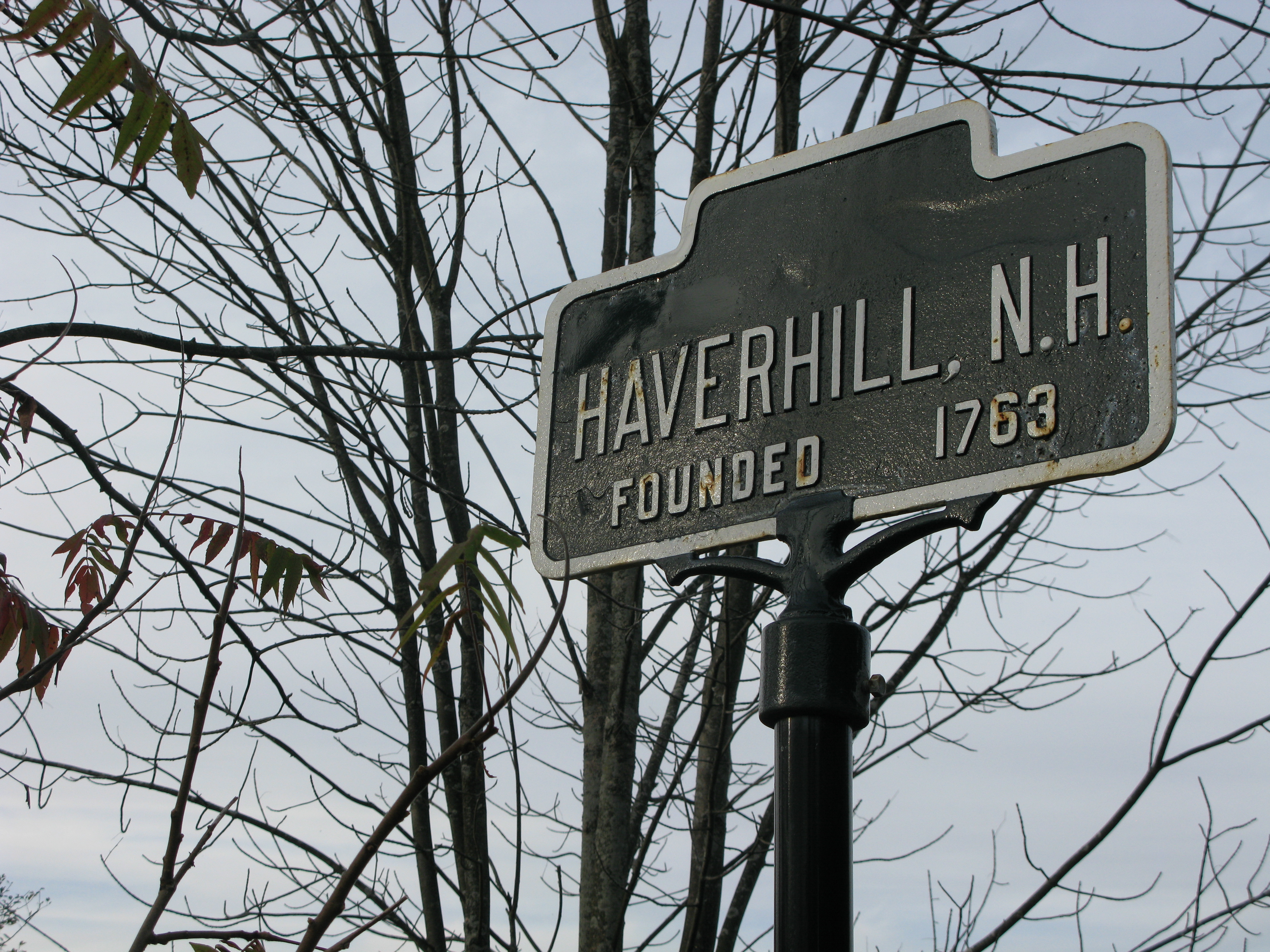
New Hampshire Public Radio has run a story about the sesquicentennial celebrations in Haverhill and Newbury.
The story begins by noting that Haverhill's history has resulted in the development of a number of distinct villages:
"If you ask people from Haverhill where they’re from, you may not get the simple answer you’d expect to get . . . "
You may read or hear the story here.
Saturday, October 26, 2013
Wednesday, October 2, 2013
Haverhill / Newbury Railroad Program
![]() |
| Boston, Concord, & Montreal RR locomotive @ Haverhill, circa 1860 |
The program will be free and open to the public. It is part of a series of programs celebrating the 250th anniversary of the founding of the two communities.
The histories of Newbury and Haverhill have been shaped by all forms of transportation, but none has been more colorful nor had greater impact than the railroads. For more than one hundred years, numerous major railroad lines crossed both towns and junctioned at the villages of Wells River and Woodsville. Upper Valley historian Jay Barrett will explore this rich and vibrant history with a profusely illustrated talk featuring many rare and seldom seen historic images.
![]() |
| BC&MRR locomotive on the Wells River / Woodsville Bridge |
Thursday, August 8, 2013
Program Cancelled!
The Historical Society regretfully announces that the program scheduled for Sunday, August 11 on the lives of Henry and Frances Parkinson Keyes has been cancelled.
If it becomes possible to reschedule the program for a future date, we will post an announcement here.
Wednesday, July 31, 2013
The Politician and the Novelist
The HHS will sponsor a program about two of the Haverhill/Newbury area’s best-known historical figures on Sunday, August 11 at 2:00 PM. “The Lives of Henry and Frances Parkinson Keyes” will be described by two of the couple’s grandchildren at Court Street Arts/Alumni Hall in Haverhill Corner. Admission is free and open to the public.
Presenter Peter Keyes is a retired teacher now living in Newbury and the proprietor of Oxbow Books. His cousin Frances Keyes Keidel lives outside Philadelphia, but spends much of her time at the ancestral family home, Pine Grove Farm in North Haverhill. They will discuss the lives and careers of their well-known grandparents.
Henry Keyes was born in 1862 in Newbury and settled at Pine Grove Farm after graduation from Harvard. He was a founder of the Woodsville Bank and served in both branches of the New Hampshire legislature and as Governor of New Hampshire for one term, 1917-1919. He is best remembered as a three-term U.S. Senator, representing New Hampshire until 1937. He died in 1938.
His wife, Frances Parkinson Keyes, was twenty-two years his junior when they married in 1903. She published her first novel in 1919 and became well known for a series of articles in Good Housekeeping magazine, “Letters from a Senator’s Wife,” about life in Washington, DC. She would go on to publish over fifty books and become one of the most popular novelists of the mid-twentieth century. Many of her books were bestsellers, and Life magazine named her one of the “three queens” of fiction in the U.S. in 1950. She died in 1970.
Keyes and Keidel will display books and memorabilia related to the lives of their grandparents. Their program is part of a series celebrating the 250th anniversary of the founding of Haverhill, New Hampshire and Newbury, Vermont.
Presenter Peter Keyes is a retired teacher now living in Newbury and the proprietor of Oxbow Books. His cousin Frances Keyes Keidel lives outside Philadelphia, but spends much of her time at the ancestral family home, Pine Grove Farm in North Haverhill. They will discuss the lives and careers of their well-known grandparents.
Henry Keyes was born in 1862 in Newbury and settled at Pine Grove Farm after graduation from Harvard. He was a founder of the Woodsville Bank and served in both branches of the New Hampshire legislature and as Governor of New Hampshire for one term, 1917-1919. He is best remembered as a three-term U.S. Senator, representing New Hampshire until 1937. He died in 1938.
His wife, Frances Parkinson Keyes, was twenty-two years his junior when they married in 1903. She published her first novel in 1919 and became well known for a series of articles in Good Housekeeping magazine, “Letters from a Senator’s Wife,” about life in Washington, DC. She would go on to publish over fifty books and become one of the most popular novelists of the mid-twentieth century. Many of her books were bestsellers, and Life magazine named her one of the “three queens” of fiction in the U.S. in 1950. She died in 1970.
Keyes and Keidel will display books and memorabilia related to the lives of their grandparents. Their program is part of a series celebrating the 250th anniversary of the founding of Haverhill, New Hampshire and Newbury, Vermont.
Monday, July 15, 2013
Haverhill Academy Building
As renovation work proceeds apace at the Haverhill Academy building (next door to Pearson Hall), Dr. Kimberly Alexander shares some information about the architect who designed the building. She begins:
"With the exciting new work underway at the Academy Building, readers may enjoy some insights into the career of the architect – Littleton-based Edward Thornton Sanderson. Sanderson designed the Academy Building in 1896-1897.
"The building is a rich combination of Richardsonian Romaneqsue style with Queen Anne overtones, such as the fabulous entry, which has recently been restored by the current owners. The Richardsonian Romanesque was popularized by the famed American architect H. H. Richardson, mastermind behind Trinity Church in Boston, among countless mid-19th century landmarks. As with its early 19th century neighbor, Pearson Hall (1816+), the Academy boasts a strong, multi stage tower which was, and still is, a highly visible local landmark. The hard, dark red brick is relived by the yellow or buff brick which highlights details on the façade and tower. The building is set on a muscular rusticated granite base. The lighter brick was in vogue for institutional buildings from the late 19th through early 20th centuries."
Her article continues here.
"With the exciting new work underway at the Academy Building, readers may enjoy some insights into the career of the architect – Littleton-based Edward Thornton Sanderson. Sanderson designed the Academy Building in 1896-1897.
"The building is a rich combination of Richardsonian Romaneqsue style with Queen Anne overtones, such as the fabulous entry, which has recently been restored by the current owners. The Richardsonian Romanesque was popularized by the famed American architect H. H. Richardson, mastermind behind Trinity Church in Boston, among countless mid-19th century landmarks. As with its early 19th century neighbor, Pearson Hall (1816+), the Academy boasts a strong, multi stage tower which was, and still is, a highly visible local landmark. The hard, dark red brick is relived by the yellow or buff brick which highlights details on the façade and tower. The building is set on a muscular rusticated granite base. The lighter brick was in vogue for institutional buildings from the late 19th through early 20th centuries."
Her article continues here.
Wednesday, June 12, 2013
Native American Program and Annual Meeting
Last year, the Historical Society hosted a program by David Stewart-Smith about Native Americans in New Hampshire during the colonial period. The event was so popular that we have invited Dr. Stewart-Smith to return to present his new program, “Native New Hampshire Before Contact: Archaeological and Tribal Perspectives.”
The program will be offered in conjunction with the Historical Society's annual meeting on Tuesday, June 18 at the Parish Hall in Haverhill Corner. The annual meeting will begin at 6:30 PM and Dr. Stewart-Smith's presentation at 7:00 PM. Note that we will NOT be meeting at the Ladd Street School.
The annual meeting will feature election of officers and reports from the board on efforts to revitalize Pearson Hall and to vacate the former museum on Court Street; on upcoming programs related to the celebration of the 250th anniversary of the founding of Haverhill; and on other activities.
David Stewart-Smith offers this description of his new program:
We hope to see you there.
The program will be offered in conjunction with the Historical Society's annual meeting on Tuesday, June 18 at the Parish Hall in Haverhill Corner. The annual meeting will begin at 6:30 PM and Dr. Stewart-Smith's presentation at 7:00 PM. Note that we will NOT be meeting at the Ladd Street School.
The annual meeting will feature election of officers and reports from the board on efforts to revitalize Pearson Hall and to vacate the former museum on Court Street; on upcoming programs related to the celebration of the 250th anniversary of the founding of Haverhill; and on other activities.
David Stewart-Smith offers this description of his new program:
Northern New England was home to the native peoples for almost 10,000 years before European contact. Natives were faced with the after-effects of an ice age, the emerging changes in ecosystem and climate, and new choices regarding materials for the making of tools, clothes, and shelter. This “prehistoric” time was anything but stagnant or sedentary; instead, it was a time of tremendous movement, energy, innovation, and survival. David Stewart-Smith reviews the three major archaeological eras and their relevance to native life.
We hope to see you there.
Thursday, May 30, 2013
Letters of Myra Montgomery
On Sunday, June 9, Dr. Kimberly Alexander will present: " 'To Vegetate in the Country...': The Haverhill Letters of Myra Montgomery, 1813-1817" at Court Street Arts/Alumni Hall in Haverhill Corner. The program begins at 2:00 PM.
This is one of a series of programs scheduled to celebrate the 250th anniversary of the founding of Haverhill, NH and Newbury, VT.
Have you ever wondered what life was like in the early years of 19th century in the North Country? Many of us imagine life in the rural Connecticut Valley two centuries ago to have been a quiet, slow round of planting and harvest, of raising families and burying the dead. As Haverhill resident Myra Montgomery put it, even back then city people imagined that their county cousins lived lives of “undisturbed calm in which one is allowed to vegetate in the country.” In actuality, life then was as complicated as our lives today. Listen in on detailed accounts of gossip, weather, fashion, bereavement and much more as told by the clever, vivacious Myra Montgomery (1794-1817). She will introduce you to Haverhill of the 1810s, the townspeople, their lives, their joys & sorrows.
Dr. Alexander has also written about these letters on the blog SilkDamask. Her post there begins:
“Approximately a dozen typescript letters written primarily by Myra Montgomery (1794-1817) to her cousin and subsequently, fiancé, Horace Henry Goodman (1785-1849) survive in the Collections of the Haverhill Historical Society, Haverhill, NH, and the New Hampshire Historical Society, Concord, NH. Although small in number, the letters nonetheless constitute a valuable source of information on an affluent young woman and her family in the early Republic. While living in a rural town, she had access to much wider intellectual, artistic and literary circles, through her Boston education at the progressive Mrs. Susanna Rowson's School and Haverhill's role as the seat of the North County Court system, which drew several hundred individuals throughout the year”
Read the rest here.
This is one of a series of programs scheduled to celebrate the 250th anniversary of the founding of Haverhill, NH and Newbury, VT.
Have you ever wondered what life was like in the early years of 19th century in the North Country? Many of us imagine life in the rural Connecticut Valley two centuries ago to have been a quiet, slow round of planting and harvest, of raising families and burying the dead. As Haverhill resident Myra Montgomery put it, even back then city people imagined that their county cousins lived lives of “undisturbed calm in which one is allowed to vegetate in the country.” In actuality, life then was as complicated as our lives today. Listen in on detailed accounts of gossip, weather, fashion, bereavement and much more as told by the clever, vivacious Myra Montgomery (1794-1817). She will introduce you to Haverhill of the 1810s, the townspeople, their lives, their joys & sorrows.
Dr. Alexander has also written about these letters on the blog SilkDamask. Her post there begins:
“Approximately a dozen typescript letters written primarily by Myra Montgomery (1794-1817) to her cousin and subsequently, fiancé, Horace Henry Goodman (1785-1849) survive in the Collections of the Haverhill Historical Society, Haverhill, NH, and the New Hampshire Historical Society, Concord, NH. Although small in number, the letters nonetheless constitute a valuable source of information on an affluent young woman and her family in the early Republic. While living in a rural town, she had access to much wider intellectual, artistic and literary circles, through her Boston education at the progressive Mrs. Susanna Rowson's School and Haverhill's role as the seat of the North County Court system, which drew several hundred individuals throughout the year”
Read the rest here.
Subscribe to:
Posts (Atom)


